

This is obviously a huge topic, and the answer will vary depending on who you are, what level you’re at, what you’re trying to get better at on the drums etc. I’m just gonna throw my relatively brief two cents out on it, and I’d also recommend taking various viewpoints of other drummers into account on this so that you can form your own overall approach to what works best for you.
In part 1 we’ll look at common pitfalls and how to get past them, and increasing the quality of your practice time, and then in part 2 we’ll look more at the details of how long you might want to practise for, how to break a new challenge down into separate chunks, and finding balance in the way you go about practising.
Common Pitfalls
There are two fairly common pitfalls that might prevent you from figuring out what you should be practising as a drummer –
1) Feeling overwhelmed, as in it feels that there is “too much to do”, you’re “too far behind”, and that you’re not sure where to begin with all of it
2) Feeling that you’ve “already done enough”, you’re “already pretty good”, and that there’s not much else that you can think of to learn
In response to 1), I would say to maybe just focus on learning the drum parts for music that you enjoy that you might not have looked at in much detail before, and possibly just picking one drummer or even one song to focus on for a while. I think this is a good way of learning and practising new things on the drums, as you’ll come across stuff that you might not have thought to play on your own, and it might force you to work on other things such as technique, coordination, structure memorisation etc. And when it’s music that you enjoy and are interested in, then you’ll feel more motivated to learn it and will get more enjoyment out of it (as opposed to learning something that “you’re supposed to learn” for the sake of it but maybe aren’t particularly interested in).
If you are earlier on in your development as a drummer and you’re not sure what kind of music or drumming that you’d like to focus on, I’d recommend going through the drum grades for a while, as you can’t really go too wrong with this, and they cover a wide range of styles and approaches to the drums. Eventually you’ll find out that you’re more drawn to a certain style or genre, and then you can start pursuing this in greater focus.
You can’t learn everything, and even the greatest drummers have their own specialisms that they focus on, and I personally feel that it makes more sense to focus on a path/style of drumming that you enjoy and want to get better at.
In response to 2), if you ever feel like this then you’ve probably stagnated a bit, and you’re definitely wrong, as there’s always new things to learn and improve upon, and it might be more the case that you need to set your sights a bit higher and give yourself a greater challenge to work towards. Again, it might be worthwhile focusing on one drummer in particular that you look up to, and striving to learn their parts and emulate their style, or another option is to simply get hold of a new drum book that covers a style or approach that you are interested in and working through this in detail for a while, purely for the sake of breaking the rut and learning something new. Have a browse on Hudson Music for instance – https://hudsonmusic.com/product-category/books/
Or simply google a type of drumming that comes to mind and see what comes up, e.g., “Latin Jazz Drumming Coordination book” or “Fast Double Pedal Drumming Exercises book”.
Time: Quality vs. Quantity

There is the matter of time, and how much you have available to dedicate to practising the drums. Although it is much more likely that you will improve as a drummer by regularly playing the drums rather than not playing at all, it is not purely a question of time, but relates more to the quality of your practice and what you choose to focus on.
I am as guilty as anyone of sometimes thrashing around on the drums with no real aim or goal in mind other than cathartic release, and I am also perhaps guilty of spending too long repeatedly playing things that I’m already confident and capable of doing just for the fun of it. But I’m aware of when I’m just playing for fun, and I know that if I want to progress and improve as a drummer, I can’t spend too long just doing this. I try and ask myself – “what do you want to learn next?” or “what would be an appropriate and reasonable challenge?” and I then look at how I’d go about doing this.
I feel that it’s important to find an appropriate challenge to work on for where you are currently at as a drummer. If you keep playing stuff that’s not much of a challenge or too easy for you, then you won’t progress much, and if you try setting your sights on something that’s unreasonably difficult for your current level then you’ll probably get stuck and crash out, or possibly even injure yourself too (beware of trying to run before you can walk). The key thing is to identify a decent and manageable challenge for your current skill level as a drummer, and to try and build your practice time around the things that are most likely to help you achieve this.
Another tip I’d like to throw in about maximising the quality of your practice time is to really try and concentrate and focus hard on what you are doing, and give it your undivided attention. You can go through the motions of practising a drum part or rudiment, but if your mind is elsewhere and you’re not fully engaged in what you are doing then will get less of a return on your practice time than if you are consciously motivated and focused on what you are doing. Let’s paraphrase Mr Arnold Schwarzenegger, who puts it into better words –
“While you’re doing an exercise, if you concentrate and visualize your muscles drums growing while commanding and demanding them to grow, the results will come much faster. The mental picture you form of what you want to be and what you want to accomplish can greatly aid your progress toward attaining those goals. I focused all of my mental concentration on accomplishing my goal whenever I was at the gym drums. Every repetition of every set blast beat was done with intense concentration. I visualized each exercise, completed each repetition and set as bringing me closer to my goal.” – https://www.muscleandfitness.com/features/active-lifestyle/arnold-schwarzeneggers-muscle-building-mental-strategy/
One last quick point about time that relates to this – there is a common misconception that your skill level as a drummer will increase in a direct linear curve in proportion to how much time you spend playing on the kit:
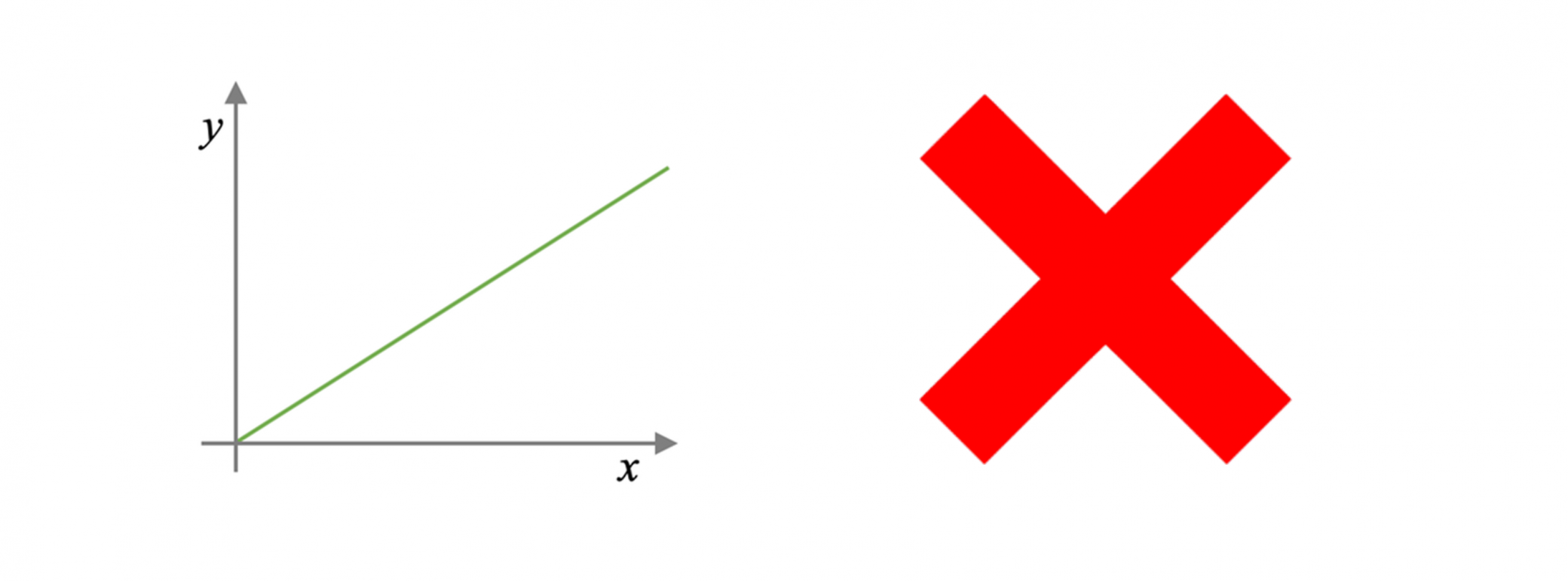
This is not always the case! Sure, sometimes you simply get better from spending more time playing drums, but it can also sometimes feel like you are stuck at a certain level for a while, or that you are even going backwards. This is perfectly normal, and I advise having patience and faith in these circumstances, and to keep practising. It might be that your expectations of your drumming have increased far ahead of your skill level, or you have developed a heightened awareness of your flaws, or that you have fatigued from practising the same thing for too long. Be patient and try adjusting your practice routine a bit, or approach the problem from a slightly different angle, and you’ll find that things just ‘click’ after a while.
In part 2 we’ll go into more detail about the ‘how?’ of practising, with a closer look at the nuts-and-bolts stuff and what your routine could look like – What Should I Practise on the Drums, and How? – Part 2
I teach drums in Brighton, and if you are interested in having lessons with me, you can find out more here.